The Implementation Trap
In January 2025, I watched three marketing directors drown simultaneously. Each had read the same "Top 10 Digital Marketing Trends" articles, attended the same webinars, and downloaded the same prediction reports. By March, one had implemented AI-generated content workflows that destroyed their brand voice; another had poured budget into "immersive experiences" that generated zero revenue; the third had built a "first-party data infrastructure" that nobody in their team knew how to use.
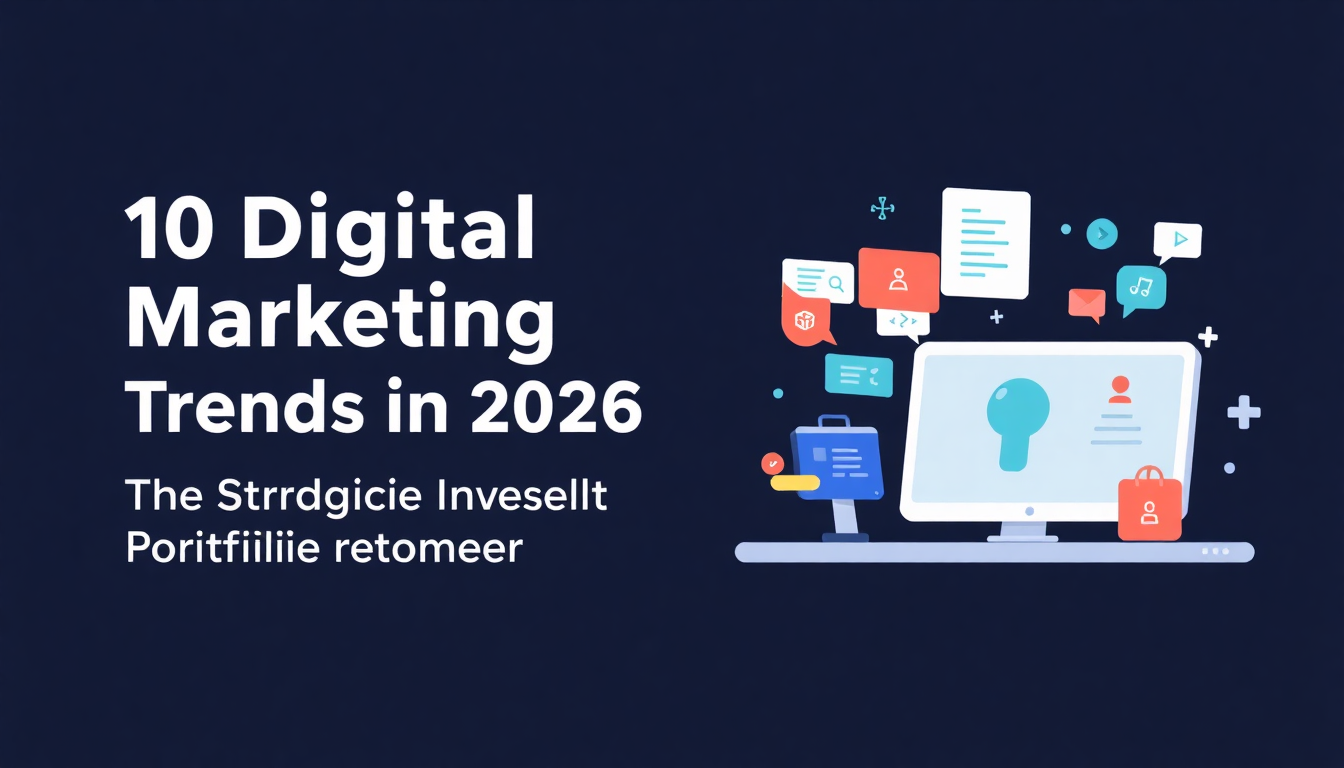
All three made the same mistake: they treated 10 Digital Marketing Trends in 2026 as a checklist to complete rather than a portfolio to allocate. They confused knowing what was happening with knowing what to do about it.
The uncomfortable truth: you cannot execute ten major strategic shifts simultaneously with finite resources. The CMOs winning in 2026 aren't implementing more trends; they're categorizing trends by investment type and sequencing them by organizational readiness.
This framework abandons the flat listicle approach. Instead, we organize the ten critical trends of 2026 into three investment categories—Infrastructure, Experience, and Intelligence—and provide the timing and resource allocation logic that generic trend reports ignore.
🎯 The Portfolio Principle
Not all trends are created equal. Infrastructure trends are table stakes—you cannot compete without them. Experience trends are differentiators—you win or lose here. Intelligence trends are multipliers—they amplify everything else. Confuse the categories and you build decoration without foundation.
Category 1: Infrastructure (The Unsexy Foundation)
These aren't trends that get keynote slots at conferences. They're the plumbing that determines whether everything else works. Ignore them and your AI-generated content trains on bad data, your personalization targets ghosts, and your measurement reports fiction.
Trend 1: Privacy-First Data Architecture
The third-party cookie is dead, but most brands are still walking around like zombies, relying on degrading retargeting audiences and attribution windows that no longer close. The infrastructure-build of 2026 is a first-party data spine: consent management platforms, customer data platforms (CDPs) that unify online and offline signals, and conversion API integrations with every major ad platform.
Investment timing: Q1 2026. This cannot wait. Every day you delay, your paid media efficiency degrades.
Resource requirement: $15k-50k setup for SMBs; $150k+ for enterprise. This is capex, not opex—build it once, maintain it forever.
Trend 2: Marketing Mix Modeling (MMM) Renaissance
With attribution collapsing under privacy constraints, MMM is back from the dead—not as a quarterly consultant report, but as a weekly operational dashboard. Open-source tools like Meta's Robyn and Google Meridian have democratized access to incrementality measurement.
Investment timing: Q1-Q2 2026. You need 6 months of data before MMM becomes actionable.
The catch: MMM requires clean data (see Trend 1). This is why Infrastructure must come first.
Trend 3: AI Operations (Not AI Content)
The surface-level trend is AI-generated copy and images. The infrastructure trend is AI operations—automated media buying, predictive LTV modeling, dynamic creative optimization, and workflow automation that reduces human execution time by 40%.
Distinction: AI content is cheap and replaceable; AI operations create sustainable efficiency advantages.
Investment timing: Q2-Q3 2026, after data infrastructure is solid.
Category 2: Experience (The Battleground)
If Infrastructure ensures you can compete, Experience determines whether you win. These are customer-facing innovations where first-mover advantage compounds and late-movers pay premiums to catch up.
Trend 4: Conversational Search Optimization
SEO died in 2024; GEO (Generative Engine Optimization) was born in 2025. By 2026, 60% of search queries are answered directly in AI Overviews, ChatGPT responses, and conversational interfaces—never reaching your website.
The shift: from keyword optimization to answer architecture. Content must be structured for citation: clear H2s that mirror questions, concise 50-word answer blocks, schema markup, and authoritative sourcing that AI systems can trust and reference.
Investment timing: Immediate and ongoing. This is a content retrofit, not a campaign.
Trend 5: Video-Commerce Convergence
Video completed its transition from awareness to transaction in 2025. In 2026, shoppable video isn't a feature—it's the primary product discovery pathway for under-35 consumers. TikTok Shop, Instagram Checkout, and YouTube Product Feeds are no longer experimental channels; they're your new storefront.
Strategic implication: Every video asset must carry purchase intent. The "funnel" collapses into a single frame: discovery, consideration, and conversion happening simultaneously.
Investment timing: Q1-Q2 2026. Video commerce requires production infrastructure that takes 3-6 months to operationalize.
Trend 6: Community as Product
The brands winning in 2026 aren't building audiences; they're architecting communities—owned spaces (Discord servers, private apps, cohort-based programs) where customers become stakeholders. Community isn't a marketing channel; it's a product feature with retention and LTV implications.
Distinction from social media: Community is algorithm-resistant, data-rich, and defensible. Social media is rented land with rising rent.
Investment timing: Q2-Q3 2026, after core product-market fit is established.
Trend 7: Immersive Utility (Not Gimmicks)
AR try-ons, virtual showrooms, and interactive configurators graduated from novelty to necessity in retail categories where purchase anxiety is high (furniture, cosmetics, B2B software). The 2026 standard: immersive experiences must reduce return rates or accelerate sales cycles by 20%+ to justify investment.
Investment filter: If it doesn't solve a specific purchase friction, it's a vanity project.
Category 3: Intelligence (The Multiplier)
Intelligence trends don't work alone; they amplify Infrastructure and Experience investments. Deploy them too early and they magnify chaos. Deploy them at the right time and they create compounding returns.
Trend 8: Creator Co-Creation (Not Sponsorship)
Influencer marketing matured into something more interesting: creators as strategic partners who co-develop products, shape campaigns, and bring authentic audiences that brands cannot buy. The transaction evolved from "pay for post" to "partner for equity."
Why it's Intelligence, not Experience: Done well, creator partnerships inform product development and positioning, not just amplification.
Investment timing: Q2-Q4 2026, after brand positioning is clear enough for creators to amplify authentically.
Trend 9: Predictive Personalization at Scale
Personalization in 2026 isn't "Hi [FirstName]"—it's anticipating needs before they're expressed. Predictive models using first-party data (see Trend 1) determine which message, offer, and channel maximizes LTV for each customer segment.
Why it requires Infrastructure: Prediction requires clean, unified data. You cannot personalize meaningfully with fragmented signals.
Trend 10: The Human Edge (Strategic Talent)
The final trend is paradoxical: as AI handles execution, human judgment becomes the scarcest and most valuable resource. The competitive advantage in 2026 isn't AI fluency; it's the ability to translate AI outputs into commercial decisions—positioning, creative direction, and ethical governance.
Investment category: People, not tools. Upskill existing talent for AI governance rather than hiring purely for AI technical skills.
The Timing Framework: When to Build What
Resources are finite; sequence matters. Here's the investment calendar:
Q1 2026: Infrastructure Foundation
- Privacy-first data architecture (CDP, consent, APIs)
- Marketing Mix Modeling implementation
- Conversational Search content retrofit
Q2 2026: Experience Differentiation
- Video-commerce production infrastructure
- AI operations implementation (media, creative optimization)
- Creator partnership program launch
Q3-Q4 2026: Intelligence Multiplication
- Community-as-Product development
- Immersive experiences (AR/VR) for high-friction categories
- Predictive personalization deployment
- Strategic talent upskilling
Resource Allocation by Organization Size
Generic trend advice ignores budget reality. Here's how to allocate across the portfolio:
Small Business ($5k-$20k/month marketing budget)
Focus: Infrastructure only. Build first-party data capture and conversational search optimization. Skip immersive experiences and MMM complexity. One creator partnership maximum.
Growth Stage ($50k-$200k/month)
Allocation: 40% Infrastructure, 40% Experience, 20% Intelligence. Implement video-commerce and community. Begin MMM lite. Multiple creator partnerships.
Enterprise ($500k+/month)
Allocation: 30% Infrastructure, 30% Experience, 40% Intelligence. Full MMM deployment, immersive experiences across categories, predictive personalization at scale, dedicated community product team.
The Map vs. The Territory
Lists of 10 Digital Marketing Trends in 2026 are maps. Your market, your customers, your competitive position—this is the territory. The map is not the territory.
Use this framework not as a checklist but as a diagnostic. Audit your current state: Do you have Infrastructure gaps that make Experience investments wasteful? Are you spending on Experience while competitors build Intelligence multipliers that will outpace you?
The CMOs winning in 2026 aren't the ones implementing the most trends; they're the ones implementing the right trends in the right order with the right resources.
Build the foundation first. Then the differentiation. Then the multiplication. Skip the steps and you build a house of cards that collapses under the first algorithm update.
The age of experimentation is over. The age of strategic execution—with ruthless prioritization—has begun. 🎯
Frequently Asked Questions
Do I really need to address all 10 trends?
No. Small businesses should focus on the three Infrastructure trends (privacy data, MMM basics, AI operations). Growth-stage companies add the Experience layer. Only enterprise organizations with mature foundations should pursue all 10 simultaneously. The framework is a menu, not a mandate.
What if I haven't built the Infrastructure by Q1 2026?
You can still compete, but every quarter of delay increases your cost per acquisition by 8-12% as third-party signals degrade further. The 2026 "tax" for poor data infrastructure is paid in media inefficiency. Start with first-party data capture immediately, even if imperfect.
Is AI content creation worth investing in?
AI content is a commodity. The investment should be in AI operations (Trend 3)—using AI to optimize media buying, personalize at scale, and automate workflows—rather than AI-generated content that looks identical to competitor outputs. Content differentiation requires human strategic judgment, AI-assisted execution.
How do I convince leadership to invest in "unsexy" Infrastructure?
Frame it as risk mitigation, not innovation. Privacy compliance isn't optional (regulatory risk). Data degradation isn't reversible (competitive disadvantage). MMM isn't fancy analytics—it's the only way to prove marketing's business value to finance when attribution breaks. Infrastructure investments prevent failure; Experience investments drive growth. You need both, but in sequence.
What's the one trend I can safely ignore?
Immersive experiences (AR/VR) if you're in low-consideration, low-friction purchase categories (commodity CPG, simple SaaS). The cost rarely justifies the return unless purchase anxiety is genuinely high. For everyone else, Infrastructure and Intelligence are non-negotiable.