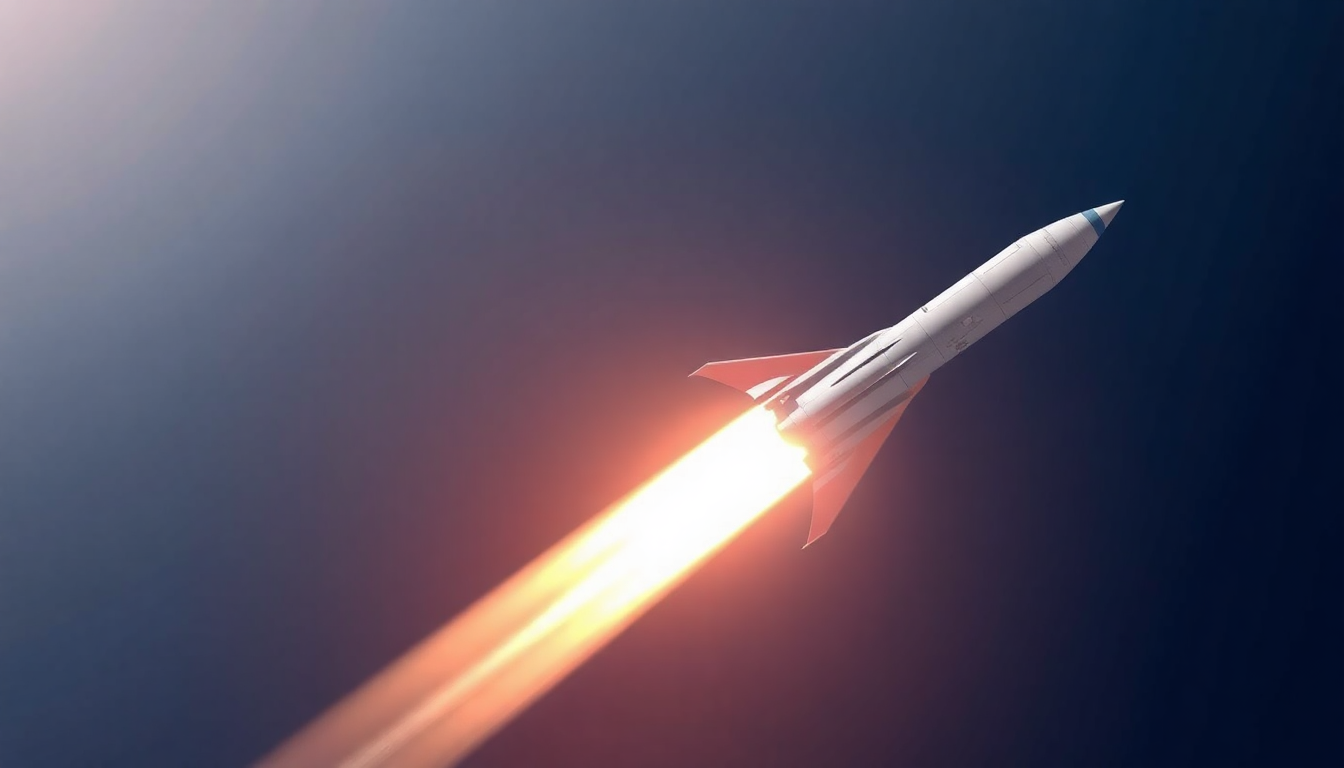
Ursa Major Stratospheric Launch: Revolutionizing Hypersonic Technology
The race to dominate hypersonic flight has entered a new phase, and Ursa Major stands at the forefront of this technological revolution. Their stratospheric launch capabilities represent a fundamental shift in how military and research organizations approach sustained flight beyond Mach 5. While competitors struggle with propulsion bottlenecks that have plagued hypersonic programs for years, this Colorado-based aerospace company has developed solutions that promise to transform the entire field.
Hypersonic flight, defined as speeds exceeding five times the speed of sound, has long captured the imagination of aerospace engineers and military strategists alike. The ability to travel from New York to London in under an hour, or to deliver payloads across continents before defenses can react, offers transformative possibilities. Yet achieving these velocities reliably and affordably has remained elusive. Ursa Major's innovations in rocket propulsion are changing that equation, making hypersonic technology accessible at scales previously considered impossible.
🚀 Technical Achievement
Ursa Major secured a $32.9 million Pentagon contract to supply 16 advanced propulsion systems for Stratolaunch's hypersonic testing program. Their engines have already powered multiple successful Talon-A missions, demonstrating sustained flight beyond Mach 5.
The Hypersonic Revolution: Ursa Major's Breakthrough
Aerospace and defense technology has reached an inflection point where hypersonic capabilities are transitioning from experimental curiosity to operational necessity. Nations worldwide recognize that controlling the high-speed domain offers strategic advantages across military, commercial, and scientific applications. Yet the path to practical hypersonic flight has been blocked by fundamental engineering challenges that Ursa Major has systematically addressed.
The company's approach centers on rethinking propulsion from first principles. Rather than accepting the limitations of existing engine designs, Ursa Major's engineers questioned basic assumptions about fuel systems, manufacturing methods, and operational requirements. This fresh perspective has yielded innovations that solve multiple problems simultaneously, creating integrated solutions where competitors patch together disparate technologies.
Chris Spagnoletti, CEO of Ursa Major, articulated the company's philosophy when discussing their HAVOC missile system. Keeping pace with our adversaries requires more than exquisite systems, he stated. It requires speed to delivery, affordability, and the ability to build at scale. This emphasis on practical deployment distinguishes Ursa Major from research programs that prioritize performance metrics over operational viability.
The Stratospheric Advantage
Launching hypersonic vehicles from stratospheric altitude offers significant advantages over ground-based alternatives. The thin atmosphere at high altitude reduces drag during initial acceleration, allowing vehicles to reach hypersonic speeds more efficiently. Stratolaunch's massive carrier aircraft, the world's largest plane by wingspan, provides an airborne launch platform that eliminates the need for extensive ground infrastructure.
Ursa Major's partnership with Stratolaunch creates a synergistic relationship between launch platform and propulsion system. The Talon-A reusable hypersonic vehicle mounts beneath the carrier aircraft's wing, then releases at altitude to fire its rocket engine. This architecture enables rapid turnaround between flights, making frequent testing economically feasible for the first time.
Inside the Draper Engine: Propulsion Reinvented
At the heart of Ursa Major's hypersonic capabilities lies the Draper engine, a liquid-fueled propulsion system that represents a fundamental departure from conventional rocket design. Developed in collaboration with the US Air Force Research Laboratory, this engine addresses longstanding limitations that have constrained hypersonic vehicle performance.
Traditional approaches to hypersonic propulsion have faced difficult trade-offs. Glide vehicles launched from high altitude rely entirely on gravity and aerodynamics, sacrificing control and maneuverability. Solid rocket boosters provide thrust but cannot be throttled or shut down once ignited. Liquid-fueled alternatives often depend on cryogenic propellants requiring complex handling procedures or toxic chemicals that create safety and logistical challenges.
The Draper engine breaks through these constraints with an innovative propellant combination and clever engineering. It runs on high-test hydrogen peroxide and kerosene, fuels that are non-cryogenic, stable at room temperature, and relatively non-toxic. These characteristics enable safer storage, simpler handling, and reduced operational complexity compared to alternatives.
Catalytic Combustion Innovation
The genius of the Draper engine lies in its catalytic decomposition system. When hydrogen peroxide flows through the engine, it encounters a catalyst that decomposes the fuel into high-pressure oxygen and steam. This reaction serves dual purposes. The steam drives the engine's turbopumps, while the oxygen combusts with kerosene in a mixture that ignites spontaneously.
This design eliminates complex ignition systems and enables capabilities impossible with conventional rockets. The engine can be throttled during flight, adjusting thrust as mission requirements demand. It can even be shut down and restarted, providing flexibility for complex flight profiles. These characteristics transform what hypersonic vehicles can accomplish, enabling sustained powered flight rather than brief boosts followed by unpowered glides.
HAVOC Missile: Affordable Hypersonic Warfare
The HAVOC missile system embodies Ursa Major's commitment to practical, producible hypersonic weapons. This medium-range vehicle achieves speeds exceeding Mach 5 while addressing the cost and manufacturing challenges that have limited hypersonic system deployment. The design philosophy prioritizes attributes that matter for operational military systems: reliability, affordability, and scalability.
Traditional hypersonic programs have produced exquisite systems in small numbers, treating each vehicle as a precision instrument requiring extensive hand-crafting. This approach creates capabilities that cannot be sustained in conflict, where losses occur and replacements must be available quickly. HAVOC represents a different paradigm, designed from inception for rapid production at volumes that operational scenarios require.
The missile achieves this manufacturability through extensive use of additive manufacturing. More than 80% of engine components are produced via 3D printing, dramatically reducing part count and simplifying assembly. Fewer parts mean fewer failure modes, faster production, and lower costs. The design also eliminates expensive thermal protection systems, further reducing both cost and complexity.
Modular Launch Architecture
Versatility characterizes the HAVOC system's launch options. Its modular design and compatibility with solid rocket boosters enable deployment from multiple platforms. Fighter aircraft, bombers, vertical launch systems, and ground-based launchers can all serve as launch points, adapting to mission requirements and available infrastructure.
This flexibility addresses a critical military need. Hypersonic weapons must integrate with existing force structures rather than requiring entirely new deployment systems. A missile that can launch from platforms already in service reduces implementation costs and accelerates operational availability. Commanders gain options for employing hypersonic capabilities across diverse scenarios.
Stratospheric Launch: The Talon-A Platform
Stratolaunch's Talon-A vehicle demonstrates the practical value of Ursa Major's propulsion technology in a reusable testing platform. This autonomous aircraft reaches speeds beyond Mach 5 while providing critical data about hypersonic flight characteristics. The Pentagon has recognized its value, contracting Stratolaunch to provide testing infrastructure for military hypersonic programs.
The Talon-A architecture solves fundamental problems that have constrained hypersonic testing. Traditional ground-based tests require expensive facilities and provide limited flight duration. Expendable test vehicles offer more realistic conditions but at prohibitive cost for extensive test programs. Talon-A bridges this gap, offering reusable high-speed flight at sustainable cost.
Mounted beneath Stratolaunch's carrier aircraft, Talon-A releases at altitude and fires its Ursa Major engine to accelerate into the hypersonic regime. After completing its test mission, the vehicle returns for recovery and refurbishment. This reusability enables iterative testing that rapidly advances technology maturity.
The Hadley Engine Evolution
Ursa Major's Hadley engine powers Talon-A missions with impressive capabilities. Producing 5,000 pounds of thrust, it operates on liquid oxygen and kerosene using an oxygen-rich staged combustion cycle. This design approach, more commonly found in large orbital-class engines, provides efficiency advantages that extend flight duration and performance.
The upgraded H13 variant, developed under the Pentagon contract, increases engine reusability with additional restart capability. Advanced materials enable more than twice as many missions compared to earlier versions, driving down cost per flight while supporting expanded test objectives. These improvements reflect Ursa Major's commitment to continuous enhancement rather than resting on initial achievements.
The $32.9 Million Pentagon Partnership
The United States Department of Defense has recognized Ursa Major's capabilities through substantial investment. A $32.9 million contract to supply 16 advanced propulsion systems for Stratolaunch reflects confidence in the company's technology and its importance for national security. This partnership extends beyond simple procurement to collaborative development of capabilities critical for maintaining technological superiority.
Dan Jablonsky, Ursa Major CEO, emphasized the strategic significance when announcing the contract. This contract directly supports U.S. hypersonic test infrastructure and the broader imperative to accelerate high-speed flight programs. His statement acknowledges the competitive context, where adversary nations are aggressively pursuing their own hypersonic capabilities.
The Pentagon's investment strategy reflects lessons learned from previous technology development programs. Rather than funding theoretical research with distant application, they are acquiring proven systems that can be deployed and refined through actual use. This approach accelerates capability maturation while providing operational utility throughout the development process.
Accelerating Defense Innovation
Traditional defense acquisition has struggled to keep pace with rapid technological change. Lengthy development cycles produce systems that are obsolete before deployment, while bureaucratic processes stifle innovation. The Ursa Major partnership represents alternative approaches that defense officials increasingly favor.
By working with agile aerospace companies, the Pentagon accesses commercial-sector innovation speed while maintaining oversight of capabilities critical to national security. Ursa Major brings Silicon Valley development practices to defense technology, iterating rapidly based on test feedback rather than following rigid specifications. This flexibility proves essential for emerging domains like hypersonics where requirements evolve as understanding deepens.
3D Printing and Manufacturing Innovation
Ursa Major's manufacturing approach exemplifies how additive technology transforms aerospace production. Traditional rocket engines require machining, welding, and assembly of hundreds of individual components. Each interface introduces potential failure points and requires inspection and quality verification. The result is expensive, time-consuming production of complex systems.
3D printing consolidates these multiple parts into integrated structures produced in single operations. Components that previously required assembly are printed as unified pieces, eliminating joints and reducing failure modes. The approach enables geometries impossible with conventional manufacturing, optimizing performance through designs that machining constraints would prohibit.
For hypersonic applications, these manufacturing advantages translate directly into operational benefits. Lower production costs enable larger inventories. Simplified designs improve reliability. Faster manufacturing responds more quickly to changing requirements. The combination addresses historical barriers that limited hypersonic system deployment.
Quality and Consistency at Scale
Additive manufacturing skeptics have questioned whether 3D printing can achieve the quality and consistency required for aerospace applications. Ursa Major's operational experience answers these concerns affirmatively. Their printed components perform reliably across multiple flight missions, demonstrating that additive technology has matured beyond prototyping into production-ready manufacturing.>
Quality control processes adapted for additive manufacturing ensure that each printed component meets specifications. In-process monitoring, post-build inspection, and statistical process control maintain consistency across production runs. The result is aerospace-grade quality achieved through methods that scale more readily than traditional manufacturing.
The Future of Hypersonic Flight Testing
Ursa Major's stratospheric launch technology enables testing regimes previously impossible. The combination of reusable vehicles, reliable propulsion, and affordable operations creates opportunities for systematic exploration of hypersonic flight physics. This knowledge foundation supports development of operational systems across military, commercial, and scientific applications.
The military implications extend beyond weapons to encompass reconnaissance, communications, and rapid response capabilities. Hypersonic aircraft could reach global destinations faster than current systems while operating outside traditional defense architectures. Understanding how to build and operate such systems requires extensive testing that Ursa Major's technology makes economically feasible.
Commercial applications, while further from realization, promise equally transformative possibilities. Hypersonic passenger travel could connect distant cities in times currently impossible. Space launch costs could decrease through reusable hypersonic first stages. Scientific research could access atmospheric regions and flight regimes currently unreachable.
International Competition and Collaboration
The global hypersonic race involves multiple nations investing heavily in related technologies. Russia, China, and several European countries maintain active programs pursuing similar capabilities. This competition drives innovation while raising concerns about stability and arms control in the high-speed domain.
Ursa Major's position as an independent propulsion provider creates interesting possibilities for international engagement. While their Pentagon contracts focus on U.S. defense applications, the underlying technology has broader relevance. The company could potentially support allied nations' hypersonic programs, strengthening collective capabilities while generating revenue for continued innovation.
Engineering Challenges Remaining
Despite impressive progress, significant engineering challenges remain before hypersonic systems achieve their full potential. Sustained flight at extreme speeds creates thermal, structural, and control problems that push materials and designs to their limits. Ursa Major's current solutions address propulsion, but integrated systems must solve multiple challenges simultaneously.
Thermal management stands among the most demanding issues. Air friction at hypersonic speeds generates temperatures that can destroy conventional materials. Advanced ceramics, refractory metals, and active cooling systems each offer partial solutions, but combining them into practical vehicles requires continued innovation. The HAVOC missile's elimination of expensive thermal protection suggests creative approaches to this challenge, but more work remains.
Control and guidance at hypersonic speeds present additional difficulties. The same atmospheric density that enables aerodynamic maneuvering also creates heating and drag. Vehicles must navigate this trade-off while maintaining precision sufficient for their missions. Testing programs using Ursa Major's propulsion systems generate data that informs solutions to these control challenges.
Conclusion
Ursa Major stratospheric launch technology represents a watershed moment in hypersonic development. By solving fundamental propulsion challenges that long constrained the field, they have enabled practical capabilities that seemed distant just years ago. The Draper engine's innovative design, the HAVOC missile's manufacturing breakthroughs, and the Talon-A platform's reusable testing architecture collectively transform what is possible in high-speed flight.
The Pentagon's substantial investment reflects recognition that hypersonic superiority has become essential for national security. Adversaries are not standing still in this domain, and maintaining technological leadership requires both innovation and deployment at scale. Ursa Major's emphasis on affordability and manufacturability addresses these requirements directly, producing capabilities that can be fielded in meaningful numbers.
Looking forward, the foundation Ursa Major has established will support expanding hypersonic applications across military, commercial, and scientific domains. Their propulsion technology enables testing that advances understanding, weapons that provide deterrence, and eventually transportation that transforms global connectivity. The stratospheric launch systems they have developed are not merely incremental improvements but fundamental enablers of a new aerospace era.
The hypersonic revolution that Ursa Major is helping to create will reshape how humanity moves through the atmosphere and beyond. Their engineering achievements demonstrate that seemingly insurmountable technical barriers can fall before persistent innovation and creative thinking. As testing continues and operational systems deploy, the full implications of their work will become apparent, establishing new possibilities for speed, reach, and capability that extend far beyond current horizons.